SKU: 100-600

Dubuque Handscrew Clamps

Regular price $19.90

Size

Dubuque Clamp Works is one of the last clamp manufacturers in the United States. They make these clamps in, where else, Dubuque, Iowa. These are traditional clamps made to the high standards you expect from a U.S.-made product. With a few of these clamps, you can perform a variety of work holding operations that would be impossible or impractical even with an army of bar clamps. Aside from the standard "pressing two pieces of wood together", these clamps can be used to create stop blocks, clamped to a work surface creating a makeshift vise, clamped in a vise to work on an odd-shaped workpiece or more comfortable working position, used to hold small workpieces against cutters, and the list goes on... These handscrew clamps are the best on the market and will last for generations.

Features:

  • Quality, hard maple jaws
  • Cold-drawn carbon steel threaded spindles and swivel nuts for ultra-smooth operation
  • Heavy ferrules with removable pins join the hardwood handles to the spindles
  • All metal parts are treated for corrosion resistance
  • Oil-treated jaws for prolonged life, check resistance, and durability

Dubuque Handscrew Clamps

Handscrew clamps may not be the first thing you think of when you think of clamps, but they are one of the most useful workholding devices in the shop. These traditional clamps from Dubuque Clamp Works are of the best quality available anywhere.


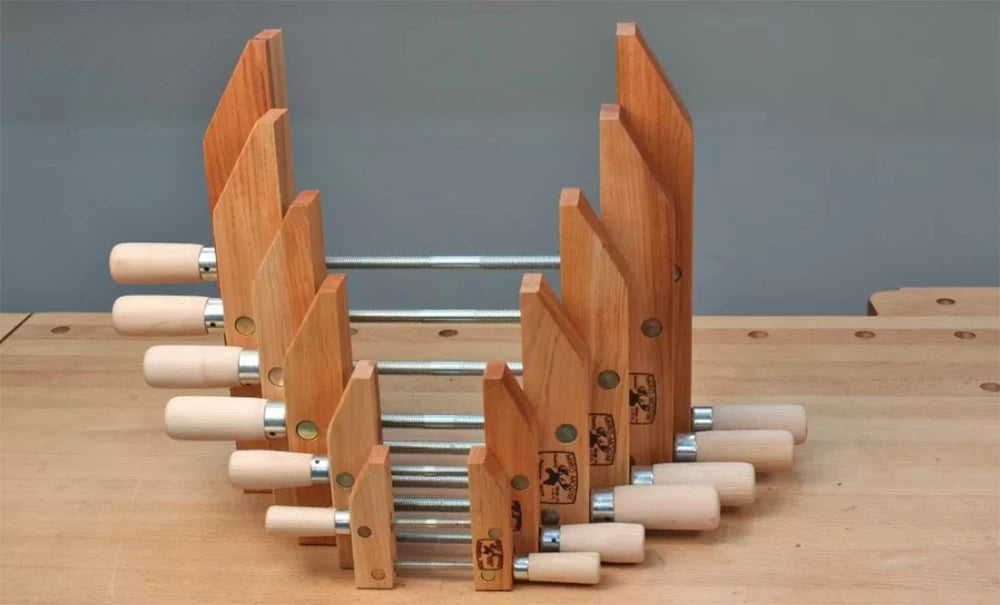
Dubuque Clamp Works wooden handscrew clamps in graduated sizes standing in a row on a workbench

You see, there's this little company in Iowa, the heartland of the U.S., that has been making quality clamps for over 40 years. And, as a friend of mine says, handscrews are classic, essential tools every woodworking shop must have.

Keith and Edna Clark are the owners of Dubuque Clamp Works and they only have a few employees. They want to keep it that way. They'd rather focus on producing quality woodworking clamps. They don't even have a web site. (They tried once but had to remove it after they got swamped with orders.)

As far as we know, Dubuque Clamp Works is now the only company in the U.S. making handscrews. (The Chicago company Adjustable Clamp Company, doing business as Pony Tools and maker of Jorgensen clamps, ceased operations on May 19, 2016 after 113 years in business.)

Pile of Dubuque handscrew clamps with maple jaws, steel spindles and wooden handles

If you've used or own handscrews from other manufacturers, chances are they were made in the Far East. I own a few. And I hate them. The jaws aren't necessarily machined square. The threads are poorly cut and sometimes bind when adjusting the jaws. And the overall fit and finish is pretty poor. I was trying to save a few bucks when I bought them.

Miro-Moose logo branded on a handscrew jaw reading Quality, Made in U.S.A., Dubuque, Iowa

I wish I had saved my pennies to purchase handscrews from Dubuque Clamp Works. Once you have one of these clamps in your hands, you're first reaction is going to be to give them a spin. Your second reaction is going to be, "Oh my goodness!" You won't believe how smoothly the spindles and nuts spin to adjust the perfectly machined, hard maple jaws. Trust me on this.

So what can you do with handscrews? A lot. I use the small 4" size as stops on my router fence and drill press fence.

Small handscrew clamped to a router table fence as a stop block

The 6" and 8" handscrews are great for holding small parts at the drill press or router table, keeping your fingers safely away from the bit and allowing you greater control over the workpiece.

Handscrew clamp holding a small workpiece on a router table, keeping fingers away from the bit

Larger handscrew clamps are great for applying pinpoint pressure in the middle of wide assemblies during glue-up.

Large handscrew applying clamping pressure to the middle of a wide panel assembly during glue-up

When hand-planing the edges of long boards at the workbench, I'll clamp one end in the face vise and use a handscrew at the opposite end to support the tail end of the board.
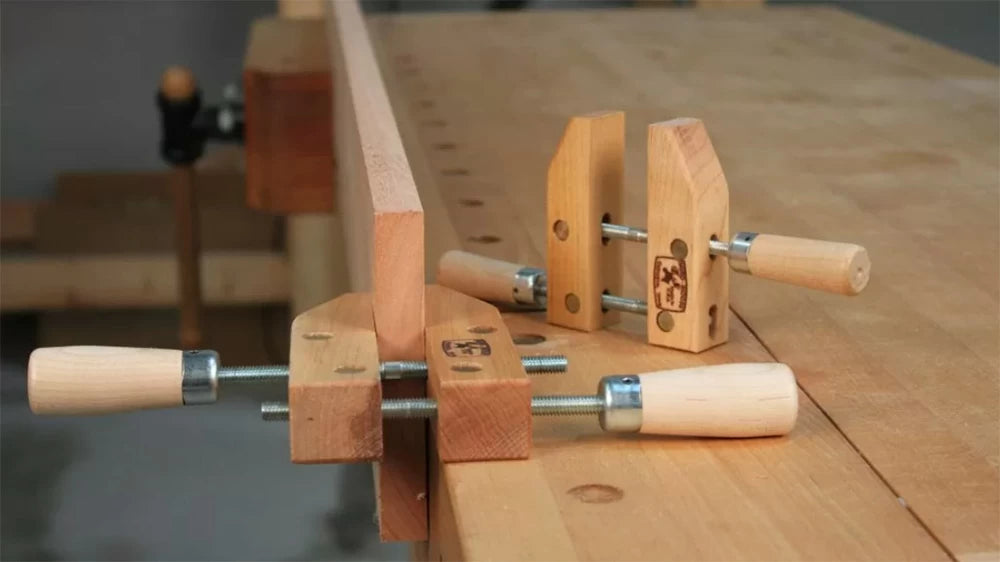
Handscrews clamped to a long board on edge to support its end while hand planing at the workbench

One popular use for handscrews is to aid in the glue-up of wide panels from multiple boards. When the jaws are configured to be parallel, they can be used to align the boards, keeping them flush as the glue dries. The end result is a smoother panel. Once you own a few handscrews, you'll find dozens of uses for them.

Handscrew with parallel jaws clamping across the joint of a glued-up panel to keep the boards flush

In case you've never owned handscrews, or have struggled with how to operate them, each handscrew from Dubuque Clamp Works comes with a quaint little tag that looks like it's right out of the 1950s.

Dubuque instruction tag: Proper Use of Your Handscrew Clamp, with diagrams on turning the middle and end spindles
Back of the tag: hard maple jaws, cold drawn carbon steel spindles, rust-treated parts and pinned steel ferrules

As you can see, Dubuque Clamp Works uses top-notch components and careful machining to produce their handscrews.

Close-up of a handscrew jaw, threaded steel spindle and steel ferrule on the wooden handle

As the tag above states, "Our company is serious about producing the best clamp made." Yes, they may cost a little more. But these clamps are a lifetime investment in tools that can be passed down for generations. Besides, your dollars help support this small manufacturer and your purchase encourages them to keep producing quality woodworking clamps. So do your part and order your handscrews today!


Frequently Asked Questions

Where are Dubuque handscrew clamps made?

They are made in Dubuque, Iowa, USA by Dubuque Clamp Works, one of the last clamp manufacturers in the United States.

What are the jaws made of?

The jaws are quality hard maple, oil-treated for prolonged life, check resistance, and durability.

What kind of spindles do these clamps use?

They use cold-drawn carbon steel threaded spindles and swivel nuts for ultra-smooth operation, with all metal parts treated for corrosion resistance.

What can I use handscrew clamps for besides clamping two boards?

They can create stop blocks, act as a makeshift vise when clamped to a surface, be mounted in a vise to hold odd-shaped work, and hold small pieces against cutters. See more clamping tools.

Why use wooden jaws instead of metal?

The maple jaws grip without marring the workpiece and conform to angled or irregular surfaces, making them well suited to delicate or odd-shaped pieces.

How do the handles attach to the spindles?

Heavy ferrules with removable pins join the hardwood handles to the spindles, a robust, serviceable design built for long-term use.

Will these clamps hold tapered or irregular workpieces?

Yes. Because each jaw adjusts independently on its spindles, the jaws can angle to grip tapered and odd-shaped workpieces securely.

How long do Dubuque handscrew clamps last?

Built to traditional U.S.-made standards with oil-treated maple jaws and corrosion-resistant hardware, they are made to last for generations.

How do these compare to bar clamps?

Handscrews excel at angled and non-parallel grips and improvised work holding, while bar clamps shine on long, parallel glue-ups. Many shops keep both. Browse bar clamps.

Can I use a handscrew clamp as a vise?

Yes. You can clamp one to a work surface to create a makeshift vise, or mount it in a bench vise to hold an odd-shaped workpiece at a comfortable angle.